


Iyer Awarded $400k Grant to Study Complexity of Fluid Flows
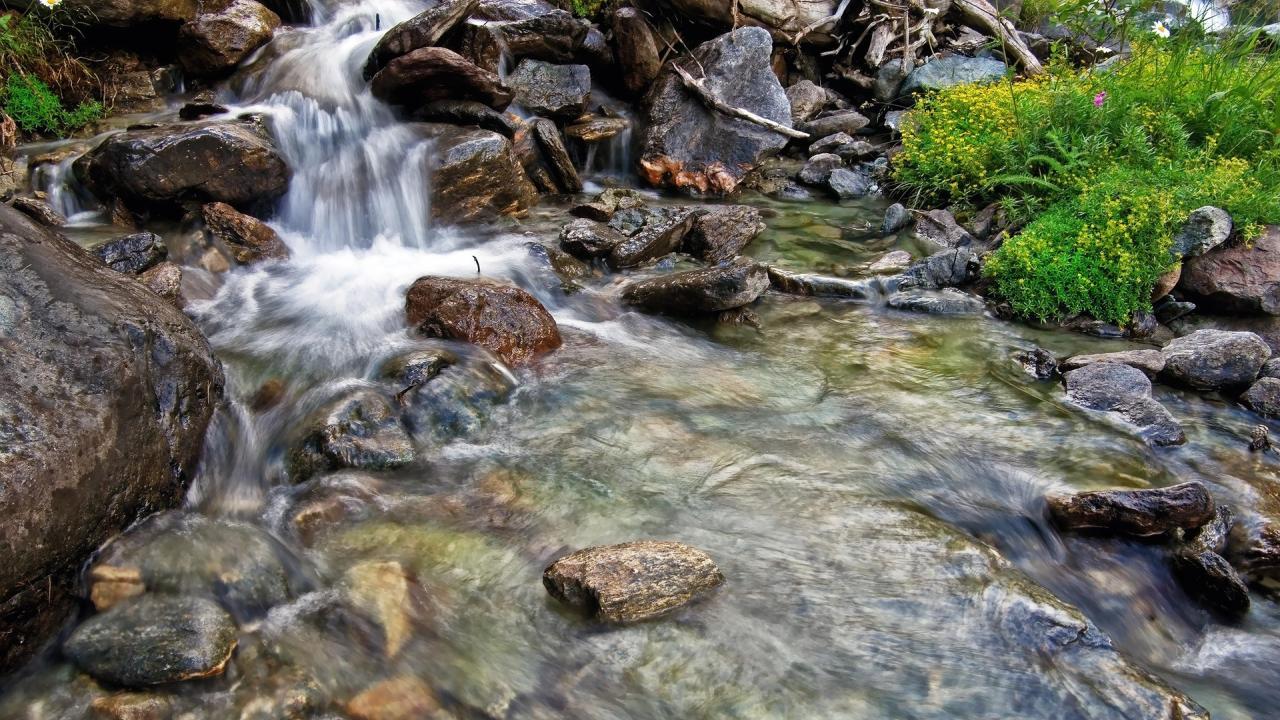
Imagine a boulder in a stream. As the water hits the boulder, it splits around the object. Once it’s passed around, the two flowing streams crash together, creating turbulent conditions that, if visible, would manifest as chaotic whorls and vortexes. This isn’t just true of water. It’s true of all fluids, including air.
The mathematical equations underlying fluid motion — known as the Navier-Stokes equations — are among the most notoriously challenging partial differential equations because in principle they encode complex behaviors similar to the one you just imagined.
Sameer Iyer, an associate professor of Mathematics at the College of Letters and Science at UC Davis, recently received a $400,000 grant from the National Science Foundation’s Faculty Early Career Development Program to advance his theoretical work on two enigmatic aspects of the Navier-Stokes equations: the boundary layer between an object and a fluid, and the large time dynamics of a fluid’s flow. The CAREER award is the National Science Foundation's most prestigious award in support of early-career faculty.
“Very complicated dynamics can appear when the fluid’s flow interacts with a solid boundary,” Iyer said. “The boundary layer is an object that we see in real life that captures this fluid-solid interaction. The mathematical puzzle is how it presents itself in the Navier-Stokes equations”
Refining Navier-Stokes equations and boundary layers
In essence, Iyer is conducting chalk and blackboard, theoretical research that aims to describe these boundary layers using reduced equations called the Prandtl equations. The goal is to bridge the gap between these reduced models and the famous Navier-Stokes equations.
Engineers consistently contend with the turbulent wakes of fluids. Such flows influence the design of airfoils, submarines and space shuttles, for example.
“When you try to simulate flow over an airplane wing or water around a submarine, it is difficult to go and program in the Navier-Stokes equations, that’s way too complicated,” Iyer said. “What you want to use is a simplified model that you hope is an accurate representation.”
“What we do is not just verify exactly when these reduced models work, but we also describe their precise behavior,” Iyer added. “These theoretical advances have the potential to impact applied disciplines by spurring design of sharper and more stable numerical methods to simulate boundary layer phenomena, more quantitative understanding of the error terms and what they depend on.”
Expanding access: education and outreach
Iyer will also use part of the NSF funding to continue popularizing the fields of theoretical and applied fluid mathematics. Already, he’s led outreach talks and courses around the world, including a minicourse on boundary layers at CY Advanced Studies in Paris and a course on hydrodynamic stability at the Simons Center for Geometry and Physics at Stony Brook University.
He plans to further develop a summer school at UC Davis for students interested in learning about boundary layers and hydrodynamic stability with the goal of lowering the barrier to entry for graduate students and early career researchers. World-renowned experts in the fields of boundary layers and hydrodynamic stability will be brought to campus for this event.
“I want to target grad students so we can increase their exposure to these fields.” he said.
Media Resources
Originally published by Letters & Science Magazine on October 14, 2025. Reprinted with permission.