by Sarah Brauner (University of Pennsylvania), Zajj Daugherty (Reed College), Sarah Mason (Wake Forest University), and Anne Schilling (University of California, Davis)
A common story in mathematics is the following: you have a large set of data, and want to find a strategic way to group that data together that makes it simpler to understand. The challenge here is to find a good way to group things that actually distills the information you have, and removes some of the “noise” of the full data set. For example, if your data set measures income by address in a city, it might make sense to group data points by neighborhood, but grouping neighborhoods this way might oversimplify the situation.
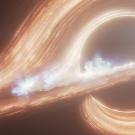
We rely on maps to make sense of the world around us. This isn’t just true for sailors navigating the oceans or families taking to the highways on vacations; it’s true for scientists who use maps of spacetime to study how empty space behaves around celestial objects such as black holes.
But for most maps, points of extreme irregularity pop up. Those points are called singularities.
What are singularities?
Singularities are geometric points where maps break down into distortions.
Mathematicians are challenging the idea that dark energy is responsible for the accelerating expansion of the universe. In a new paper published in Proceedings of the Royal Society A, mathematicians from the University of California, Davis (Blake Temple, and prior graduate students C. Alexander (2022) and Z.
UC Davis has had a long history of fostering research for all it's members and students. It's always important to revisit and adjust programs over time, and now a greater focus is being directed once again at undergraduate opportunities.
Wein and Iyer's NSF CAREER awards. Krener recognized with Quazza Medal. Shkoller and Fraas speak at ICMP 2024. Jacob et al win 2024 Frontiers of Science Award. Vazquez elected AAAS Fellow. De Loera, Schilling, and Thomas recognized for teaching and leadership. Xu wins INFORMS award. Casals awarded MCA Prize. Shkoller to lead COMPASS team.
Imagine a boulder in a stream. As the water hits the boulder, it splits around the object. Once it’s passed around, the two flowing streams crash together, creating turbulent conditions that, if visible, would manifest as chaotic whorls and vortexes. This isn’t just true of water. It’s true of all fluids, including air.
The mathematical equations underlying fluid motion — known as the Navier-Stokes equations — are among the most notoriously challenging partial differential equations because in principle they encode complex behaviors similar to the one you just imagined.
Your DNA contains the genetic blueprint necessary to not just build your body but to build the proteins and molecules that ensure your body’s functionality. DNA encodes RNA, RNA encodes proteins and voila, your body functions.
But the biological reality of this process is much more complex. The shapes, twists and entanglements of your DNA and RNA— their topology — influence their functionality and your health. Damage to DNA, like radiation exposure leading to double-strand breaks, can cause mutations that develop into diseases like cancer.
The equations and theorems were sand scribbles written in the beach by Anne Schilling’s father, a physicist who worked at the European Organization for Nuclear Research (CERN). As her father wrote, Schilling absorbed as much of the information as possible before the Atlantic Ocean’s waves washed the mathematics away, the seafoam acting like an eraser on a blackboard.
On a Sunday morning in September 2023, UC Davis mathematician Roger Casals Gutiérrez was entranced by something he saw in his kitchen.
As sunlight filtered through the kitchen window, it cast its rays in a beautiful pattern on the wall. Comprised of lines, curves and points of varying illumination, the projected pattern appeared both circular and triangular, a hodgepodge of intersecting, nebulous shapes with various spots of brightness.