


Equations in the Sand
Anne Schilling Discusses the Predictive Power of Mathematics
The equations and theorems were sand scribbles written in the beach by Anne Schilling’s father, a physicist who worked at the European Organization for Nuclear Research (CERN). As her father wrote, Schilling absorbed as much of the information as possible before the Atlantic Ocean’s waves washed the mathematics away, the seafoam acting like an eraser on a blackboard.
For Schilling, that moment as a 15-year-old learning the fundamentals of calculus was a turning point. Math was more than just calculating, she realized. It was theoretical and could be used to describe reality.
Mathematics permeates our lives. It's there even when it escapes our comprehension.
Take your t-shirt drawer, for instance. There’s a high probability that your favorite shirts are at the top of the drawer, given that you wear and wash them more. Your least favorite shirts? Probably at the bottom.
“That’s called a stationary distribution, and mathematicians would like to find a formula to describe this stationary distribution,” said Schilling, now a professor in the Department of Mathematics at the College of Letters and Science at UC Davis. “How quickly do you actually get to this stationary distribution?”
This stationary distribution is the result of time, affected by how the shirts mix as you wear, wash and restock them.
Stationary distributions are components of a mathematical concept called “Markov chains,” which are probability models that describe the sequence of events/states based on the past. It’s a concept that can be applied to a lot more than just your dresser drawer, including weather, voting procedures and quantum physics.
Visualizing Markov chains
The potential predictive applications of Markov chains make them a ripe ground for foundational research. That’s where Schilling comes in. She and colleagues recently developed a unified theory for finite Markov chains, enabling researchers to compute a Markov chain’s stationary distribution.
“The theoretical background that we have developed comes from what’s called ‘semigroup theory,’” Schilling said. “Semigroup theory is something that describes symmetry in nature, so semigroups are fundamental structures and we can use them to describe these Markov chains.”
Many of these structures are discrete objects, meaning they are distinct rather than continuous, countable like an integer.
“If you have something that is discrete, something that you can count that’s not continuous, it’s actually amenable to put on the computer,” Schilling said. “We program these structures on a computer and we sort of look for certain things.”
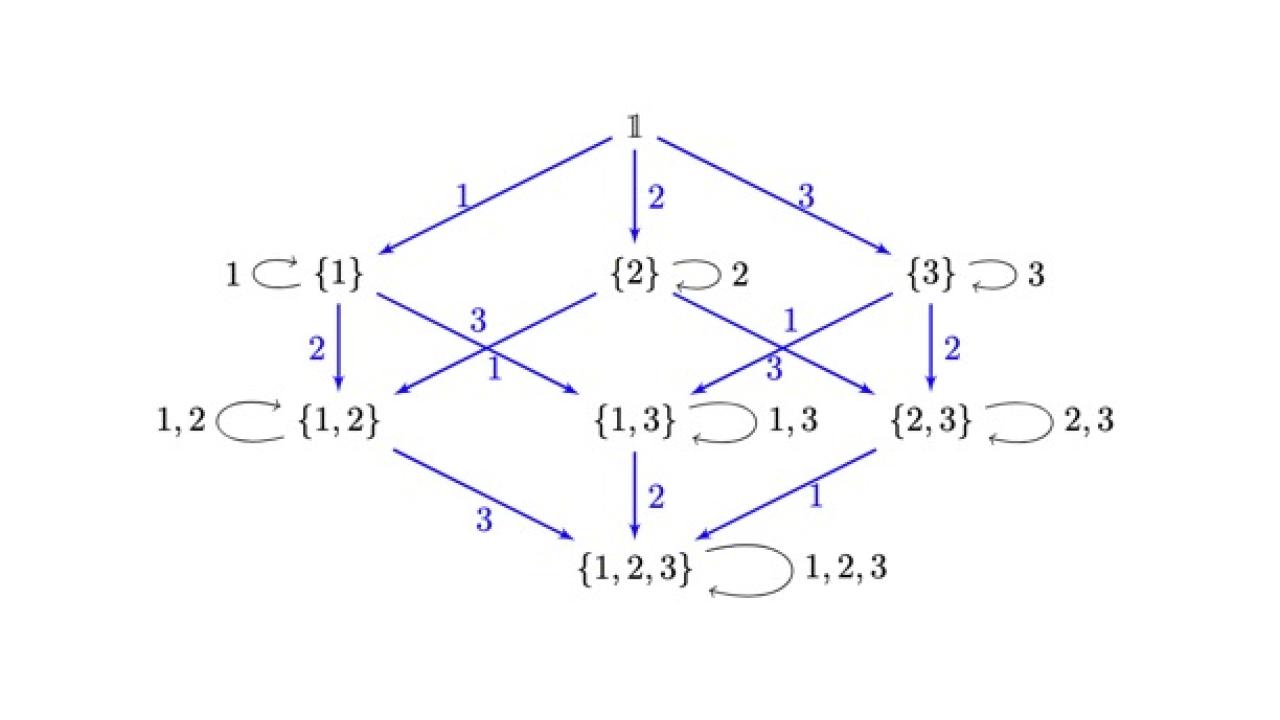
Markov chains manifest as Cayley graphs. These graphs enable mathematicians to view Markov chains as geometric structures, which can be programmed into a computer.
“Analyzing such a graph helps us to understand the Markov chain,” Schilling said. “We stare at these graphs and we see all their loops and points and it tells us something about the mixing time. We can look at these graphs, find properties and make conjectures, and once we have these conjectures, we can try and see whether we can actually prove them.”
A commitment to open access
Schilling and her colleagues visualize Markov chains using SageMath, an open-source mathematics software program. Schilling described the program as being "developed by mathematicians for mathematicians” who have full access to its database of code.
“We can actually see the code, and if there’s something wrong with it, we can fix it,” she said, noting how users help shape the platform and its functionality.
In addition to contributing to SageMath, Schilling is also committed to open access publishing. She’s one of the handling editors of Combinatorial Theory, a journal published by the University of California. Academics can contribute to the journal for free and readers can access the journal’s contents for free.
While Schilling’s research on Markov chains has many potential applications, from weather prediction to quantum physics, her focus is more foundational.
“My research is very fundamental. It’s more the curiosity-driven side and developing the underlying mathematics,” she said.
That foundational research can then be passed on to other researchers who want to employ the power of Markov chains in their research.
The research reported on in this article was funded by a $200,894 multi-year grant from the National Science Foundation.
Media Resources
Originally published by Letters & Science Magazine on August 8, 2025. Reprinted with permission.