


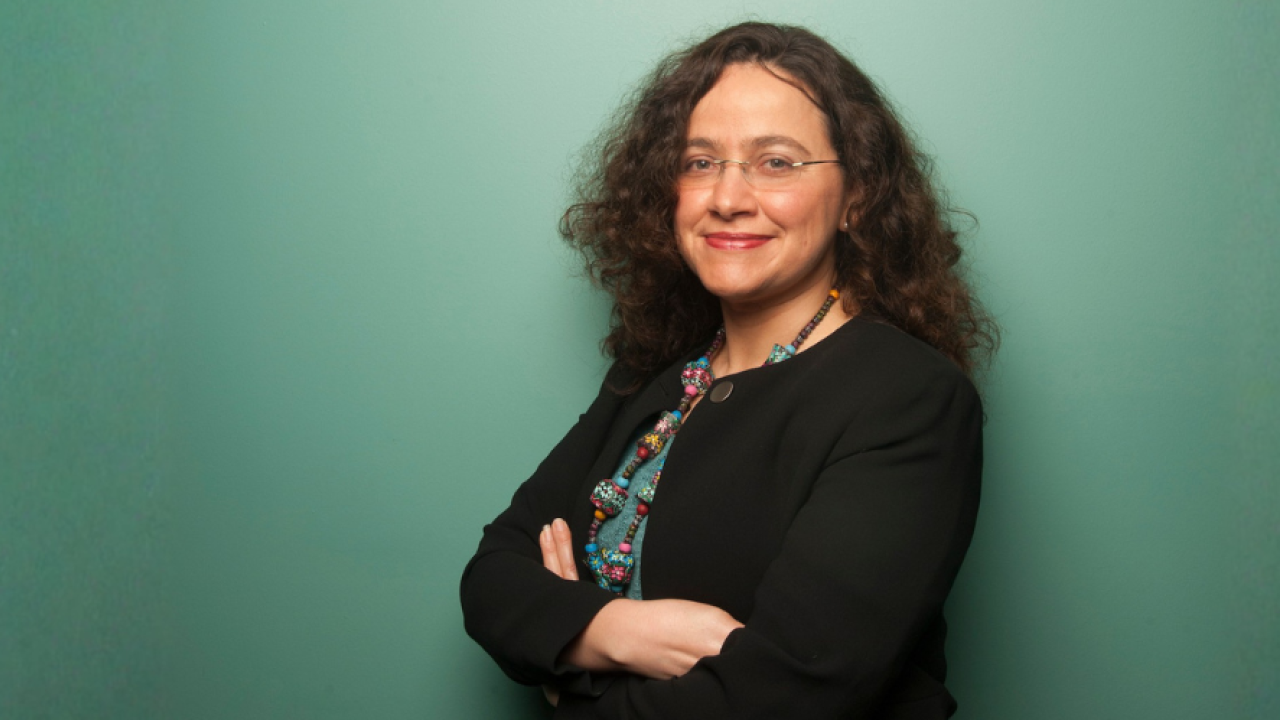
In Memoriam: Mariel Vazquez
February 24, 1971 - July 5, 2026
With deep sorrow we report the news of the passing of Mariel Vazquez on July 5, 2026, at the age of 55. Mariel was an esteemed applied mathematician and an internationally recognized member of the scientific community. She was well known for applying knot theory and topology to DNA and influencing the development of the field of DNA topology. Mariel leaves behind a distinguished academic career and a trail of devoted students and collaborators.
Mariel was born in Mexico and pursued her undergraduate studies in Mathematics in the Faculty of Sciences of the National Autonomous University of Mexico (UNAM) as a scholarship recipient. She graduated in 1995 with a thesis titled "Applications of Knot Theory to the Study of DNA," supervised by Dr. Max Neumann. She then moved to the United States to pursue graduate studies in mathematical applications to molecular biology at Florida State University under the supervision of Dr. De Witt Sumners. She completed her Ph.D. in 2000 in DNA topology and began her professional career with a postdoctoral appointment at the University of California at Berkeley (2000-2005), followed by a faculty position at San Francisco State University. In 2014, she moved to the University of California at Davis as a Professor with a joint appointment in the Department of Mathematics and the Department of Microbiology and Molecular Genetics. Mariel’s research lay at the intersection of mathematics, polymer physics, and molecular biology, specializing in applying topological tools to study DNA and RNA structure. Her work influenced our knowledge of DNA chromosomal and viral packing, DNA knotting, as well as the structure of DNA:RNA hybrids.
Throughout her career, Mariel received numerous awards and recognitions, including the 2012 Presidential Early Career Award (PECASE), the U.S. government's highest honor for investigators in the early stages of their careers. The award is made by invitation only, based on nominations from federal agencies and departments, for pioneering work that holds the promise of keeping the nation at the forefront of science and technology. She was also awarded the Blackwell-Tapia Prize in 2016, became an inaugural fellow for the Association for Women in Mathematics in 2018, a fellow of the American Mathematical Society in 2000, and a fellow of the American Association for the Advancement of Science in 2023.
Mariel was heavily engaged in the community with tireless advocacy for equitable access to Science, Technology, Engineering and Mathematics (STEM), through professional service and through mentoring of students and faculty. She was a director of CAMPOS, the Center for the Advancement of Multicultural Perspectives on Science, receiving a grant from the Alfred P. Sloan Foundation for her work. This work was also recognized by a 2024 UC Davis Chancellor’s Achievement Award. She was deeply connected to mathematical institutes such as the Simons Laufer Mathematical Sciences Institute (SLMath, formerly MSRI) and the Institute for Pure and Applied Mathematics (IPAM) through organizing research programs, their governance, and her commitment to promoting the mathematical sciences for all. Mariel maintained a close relationship with the Centro de Investigación en Matemáticas (CIMAT) in Mexico, having visited on numerous occasions, collaborating with the Topology group, and actively participating in the Fico González Acuña School on Knots and 3-Manifolds. Her scientific rigor, generosity in sharing ideas, personal warmth, and willingness to collaborate left a profound mark on these communities.

Those of us who had the opportunity to know and work with her will remember not only an exceptional scientist but also a generous colleague committed to the advancement of mathematics and its applications to the biological sciences. She was a dear friend, a valued colleague, and a cherished collaborator whose generosity and kindness has influenced numerous students and researchers. Her scientific and personal legacy will endure among us.
Mariel is survived by her husband, Javier Arsuaga, their children Eithne and Cedric Arsuaga-Vazquez, her parents Maria Elena and Rolando Antonio, brother David (Rosalba) and family, sister-in-law Begoña (Mark), and a host of beloved cousins, aunts, and uncles. She is dearly missed by all who knew her.
The community is invited to show their appreciation of Mariel’s impact on science and society through donations to the Mariel Vazquez Endowment for Undergraduate Research at the UC Davis Give website for the College of Biological Sciences.
There will be a celebration of life hosted at The International House of UC Davis on October 27th from 4-7 pm. The family asks that attendees refrain from wearing black and extends an invitation to everyone to come in their culturally significant dress of choice.
Media Resources
For More on Mariel Vazquez's Research
Selected Research
- Knotting probability of DNA molecules confined in restricted volumes: DNA knotting in phage capsids. J Arsuaga, M Vázquez, S Trigueros, DW Sumners, J Roca. Proceedings of the National Academy of Sciences 99 (8), 5373-5377, 2002.
- DNA knots reveal a chiral organization of DNA in phage capsids. J Arsuaga, M Vazquez, P McGuirk, S Trigueros, DW Sumners, J Roca. Proceedings of the National Academy of Sciences 102 (26), 9165-9169, 2005.
- Radiation‐induced chromosome aberrations: insights gained from biophysical modeling. L Hlatky, RK Sachs, M Vazquez, MN Cornforth. Bioessays 24 (8), 714-723, 2002.
- Entanglement statistics of polymers in a lattice tube and unknotting of 4-plats. Nicholas R Beaton, Kai Ishihara, Mahshid Atapour, Jeremy W Eng, Mariel Vazquez, Koya Shimokawa, Christine E Soteros. Discrete Applied Mathematics 379, 242-271, 2026.
- FtsK-dependent XerCD-dif recombination unlinks replication catenanes in a stepwise manner. K Shimokawa, K Ishihara, I Grainge, DJ Sherratt, M Vazquez. Proceedings of the National Academy of Sciences 110 (52), 20906-20911, 2013.
More Memories of Mariel Vazquez
- Remembering Mariel Vazquez, on the College of Biological Sciences website
- Using Language Modeling to Predict DNA Shapes, October 2025
- Discovering Curiousity: The Tangled Fate of Math and Biology, October 2019